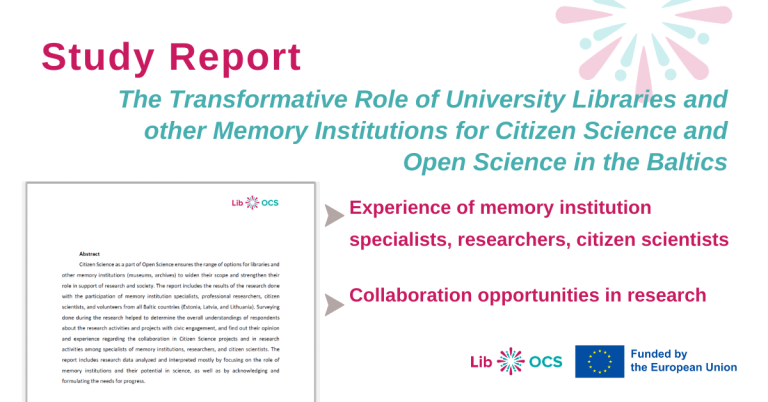
The aim of the study was to learn about the memory institution, especially the roles of libraries and their involvement in research. This question was studied in the aspect of open science, with special emphasis in the context of citizen science. It is citizen science that currently opens the possibility for libraries and other memory institutions to expand their field of activity and strengthen their importance in research and society.
During the research, over the span of several months, two surveys were conducted both in the spring and in the summer, inviting the employees of higher education and research institutions and memory institutions in the Baltic States to fill in specially created and distributed questionnaires. The two surveys that took place, in which three different groups of respondents were surveyed – memory institution specialists, researchers and amateur researchers – allowed us to conclude that citizen science is perceived positively, as well as that it is closely related not only to support for science, but also public welfare and education.
The information obtained as a result of the questionnaire was encouraging, which confirms that the three groups of respondents addressed in the Baltic States express their desire to cooperate in the implementation of citizen science projects and other research activities. Both researchers and amateur researchers greatly appreciate the contribution of the staff of memory institutions in the research projects, where they have contributed their professional knowledge and skills, as well as skills not directly related to their daily work.
Based on the data obtained in the study and the extensive information, recommendations were prepared for memory institutions to promote their transformation to increase their potential and develop services for research support. One key takeaway was that memory professionals need to increase awareness of their diverse roles in research, with an emphasis on citizen science. There were also recommendations for researchers and amateur researchers. For example, both researchers and amateur researchers should become more familiar with the range of services offered by libraries and other memory institutions, and if necessary, if it’s possible, involve libraries and other memory institutions in citizen science projects.
After conducting the study, its authors have gained positive insights, as the questionnaires confirmed that the cooperation of memory institutions, researchers and amateur researchers brings potential for the development of open science and knowledge society .
The report is available in the “LibOCS” project material collection on the Zenodo here.