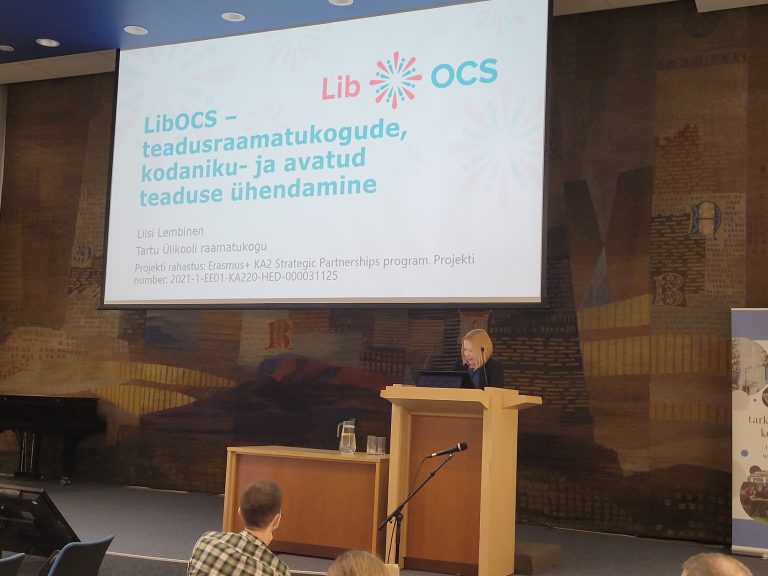
On the 7th of March, a traditional Estonian Memory Institutions’ Winter seminar took place in Tartu. The main topic of the Seminar was Citizen Science. We explored various Citizen Science projects in Estonia and the lessons learned from these. For example, the INOS project (@INOSproject) shared their results from implementing #CitizenScience activities in higher education and libraries. We also gave a short introduction and an overview of the main goals of the LibOCS project.
Liisi Lembinen presenting LibOCS project
At the end of the Seminar, we held a workshop for all participants to discuss citizen science experiences in memory institutions. As there were people from universities, libraries, museums, we first asked them what they consider citizen science. Interestingly people had different opinions – while some thought that it had to contribute to science somehow, others also saw community projects such as “Teeme ära!” as a citizen science project. We concluded that there is quite a lot of confusion around what terms and expressions to use that describe the context of citizen science. We then asked the participants how memory institutions can actively contribute to citizen science. The overall discussion concentrated on the infrastructure and what we can offer to the community or scientists. Memory institutions are more seen in a supportive role than active participants. However, we realized that memory institutions could be more actively involved by using the community to help catalogue our collections, train stakeholders, offer digital preservation, and so on. All participants agreed that the specialists who work in the memory institutions already have many skills that can benefit citizen science projects; however, we do not have enough information about ongoing projects and what type of help or resources are needed.
Based on the feedback from the discussion, we can now move on to stakeholder roundtables which will help achieve LibOCS PR1 results.